
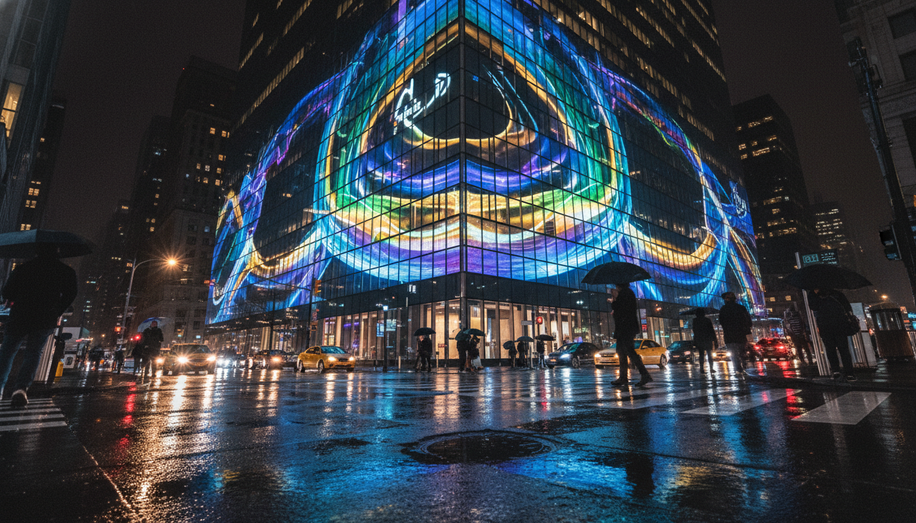

In the heart of bustling city squares and high-traffic thoroughfares, out-of-home (OOH) advertising is evolving beyond its commercial roots, morphing into immersive art installations that challenge passersby to pause, engage, and reflect. These campaigns, often temporary spectacles or enduring fixtures, fuse brand messaging with public aesthetics, turning urban landscapes into dynamic galleries where commerce and creativity converge. What was once dismissed as visual clutter now elevates cityscapes, inviting pedestrians to interact rather than ignore.
Consider the transformative power of experiential OOH, where static billboards give way to multisensory encounters. Brands leverage these formats to engage sight, sound, touch, and even scent, crafting experiences that linger in memory far longer than a fleeting glance. A prime example is the rise of 3D special builds, like the massive anamorphic shopping bag installed in a crowded mall, which not only promoted a retail brand but doubled as a navigational landmark, drawing crowds who snapped photos and extended dwell time. Such installations employ optical illusions—3D anamorphism that makes flat surfaces burst into lifelike dimensions—proving that when OOH surprises, it boosts brand recall, sentiment, and purchase intent over conventional displays.
This blurring of lines reaches its zenith in campaigns that function dually as advertising and public art. People don’t just encounter these works; they seek them out, document them, and spark conversations, amplifying reach through organic social sharing. In London, nākd’s towering 3D billboard depicted a fruit bursting from its frame, an optical marvel that turned a busy intersection into a photo-op gallery, seamlessly weaving health messaging into the urban fabric. Similarly, interactive billboards have redefined engagement: one installation methodically printed sheets to unveil a full ad, rewarding patient onlookers with a live-reveal spectacle that felt more like performance art than promotion. These aren’t mere ads; they’re interventions that humanize brands, fostering emotional connections in public spaces.
Technology accelerates this fusion, propelling OOH into the realm of digital dynamism. Digital out-of-home (DOOH) screens, once bland replacements for posters, now pulse with interactive feeds—weather updates, social media walls, or augmented reality (AR) overlays that turn static visuals into viral touchpoints. AR, in particular, invites smartphone users to scan billboards for hidden layers: a simple poster might animate into a 3D brand universe, blending the physical street with virtual wonder. Abu Dhabi’s forthcoming Sphere entertainment venue exemplifies this on a grand scale, promising tech-driven displays that reinvigorate public areas, where advertising merges with immersive spectacles akin to monumental art. Custom objects in train stations or malls, infused with audio and aroma, further exemplify how OOH becomes experiential sculpture, transforming transit hubs into brand-activated zones.
Critics might argue this elevates advertising at the expense of pure art, yet the evidence suggests mutual benefit. When OOH transcends sales pitches to enhance urban beauty, it garners public goodwill; installations that provide “genuine value or surprise” outperform traditional formats in measurable metrics. Experiential OOH humanizes corporations, turning passive viewers into participants who share stories online, driving awareness exponentially. From pop-up performances to AR-enhanced murals, these works invite a “new kind of attention,” as one observer noted, positioning brands as cultural contributors rather than intruders.
Permanent fixtures take this ethos further, embedding advertising into city infrastructure. Imagine a subway entrance reimagined as a glowing, interactive sculpture promoting sustainable transport—its brand logo subtle amid swirling light patterns that guide commuters while evoking abstract expressionism. Such integrations, outlined in OOH best practices, span formats from roadside posters to experiential builds, proving versatility in blurring boundaries. In New York or Tokyo, temporary installations like massive balloon clusters or kinetic wind sculptures have lingered in collective memory, their commercial origins secondary to aesthetic impact.
Yet challenges persist: not every campaign succeeds. Overly gimmicky efforts risk alienating audiences, underscoring the need for authenticity—art that serves the message without overwhelming it. Success hinges on context: high-footfall zones amplify immersion, while thoughtful design ensures inclusivity, from scalable AR for all devices to accessible physical elements.
Ultimately, OOH as experiential art redefines public space. By prioritizing storytelling over shouting, brands like those behind nākd or Sphere ventures enhance city aesthetics, proving advertising can coexist with—and elevate—culture. As urban dwellers crave meaning amid the mundane, these installations signal a maturing medium: one where commerce inspires, provokes, and beautifies, leaving indelible marks on both skyline and psyche. In an era of digital fatigue, OOH’s tangible magic offers a refreshing canvas, where the line between ad and art dissolves into shared urban poetry.