
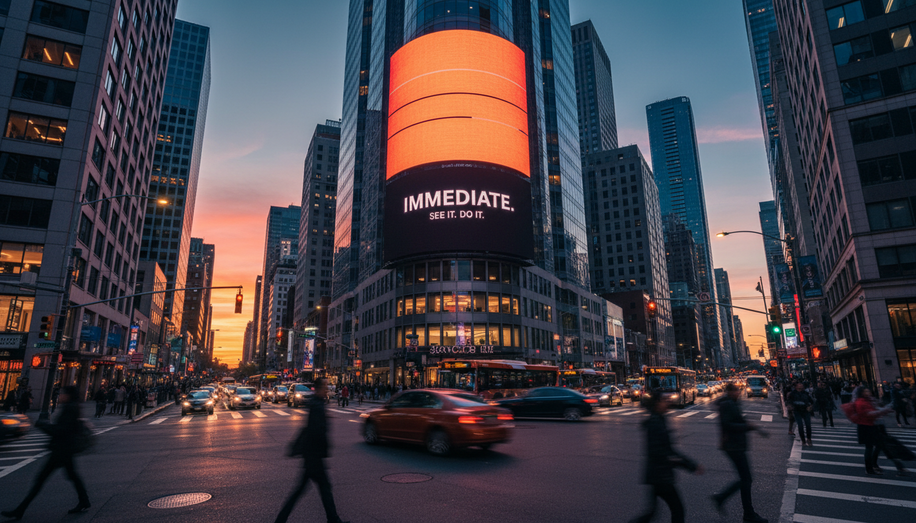

In the fleeting world of out-of-home advertising, where a driver zipping by at 65 miles per hour has mere seconds to register your message, copywriters face a brutal reality: the 7-second sell. This unspoken rule dictates that effective OOH copy must land its punch in under seven words, or risk vanishing into the blur of urban motion. Research underscores the stakes; ads with just two message elements are 21% more likely to be noticed than those cluttered with five, proving that less is not just more—it’s essential.
The challenge stems from the medium’s unforgiving environment. Unlike digital scrolls or print pages, OOH demands instant comprehension amid distractions: traffic, passengers, deadlines. Viewers aren’t pausing; they’re glancing from peripheral vision, often in under seven seconds. Traditional copywriting luxuries like nuance or elaboration evaporate. A billboard isn’t a novel—it’s a flash in the pan. Overload it with details, and it becomes visual noise. As one expert puts it, drivers aren’t waiting for your ad; they’re watching the road, mirrors, and kids in the back. Success hinges on making the message “stupidly easy”: no squinting, no puzzling, just pure, immediate impact.
Mastery begins with brevity as the cornerstone. The industry benchmark is crystal clear: seven words or fewer for headlines, ensuring readability at high speeds. This isn’t arbitrary; it’s physics and psychology combined. Letters must dominate from afar, dwarfing even a 672-square-foot canvas. Bold, sans-serif fonts in high-contrast colors triumph over fancy calligraphy or subdued palettes, which blur at distance. Count every character ruthlessly—if your pitch exceeds seven in the headline, including logo and call-to-action, you’re overreaching. Pioneering campaigns like “ROOF” or “GOT LEAKS?” exemplify this: one raw idea, hammered home without apology.
Visual synergy elevates the sparse text. Imagery isn’t decoration; it’s the hook that amplifies words. High-resolution photos of a dripping faucet beside “GOT LEAKS?” or a mouthwatering burger under “BURGERS” forge instant emotional connections. Colors, positioning, and tone must align—no clashing schemes that confuse the eye. Responsible choices matter too; OOH reaches all ages without filters, so innuendos or culturally insensitive visuals demand scrutiny to avoid backlash. The goal: a “Now that I have your attention” reveal that pairs shock or charm with the copy, prompting shares on social media.
Memorability seals the deal, turning glances into conversations. Humor works, but cautiously—one person’s wit is another’s offense. Industry jargon? Skip it; aim for universal appeal that even a receptionist can relay. Emotional triggers dominate, as 70% of decisions are gut-driven. Every OOH ad is a call to action, so embed easy cues: vanity phone numbers, short URLs, or hashtags that linger. Simplicity breeds shareability; a clever phrase that sticks gets snapped and spread.
Creativity thrives under these constraints, forcing innovation. Start with a brain dump—every wild idea, no judgments—then refine for the one core truth: what’s new, unique, or urgent? Consider the audience’s viewpoint: highway commuters need bombast; transit riders, subtlety. Refresh creative every two months to combat fatigue; notice rates drop from 50% at one month to 25% by three. Test perspectives—car, train, sidewalk—to ensure scalability.
Yet pitfalls abound. Text-heavy designs drown in competition, even on vast surfaces. Serif fonts or QR codes fail at speed; abstract artsiness baffles. Multifaceted pitches like “quality roofing with 20 years experience and free quotes” splinter focus. The antidote: minimalism that’s clever but not cryptic, bold yet responsible.
In practice, legends like these principles prove their worth. A roofer’s “GOT LEAKS?” with a leaky ceiling image doesn’t sell features—it sells relief, instantly. Refreshing rotations keep it potent, while emotional resonance ensures recall. OOH copywriters who internalize the 7-second sell don’t just advertise; they hijack attention, converting passersby into customers with ruthless efficiency. In a saturated landscape, this art form rewards the disciplined: short, visible, unforgettable.