
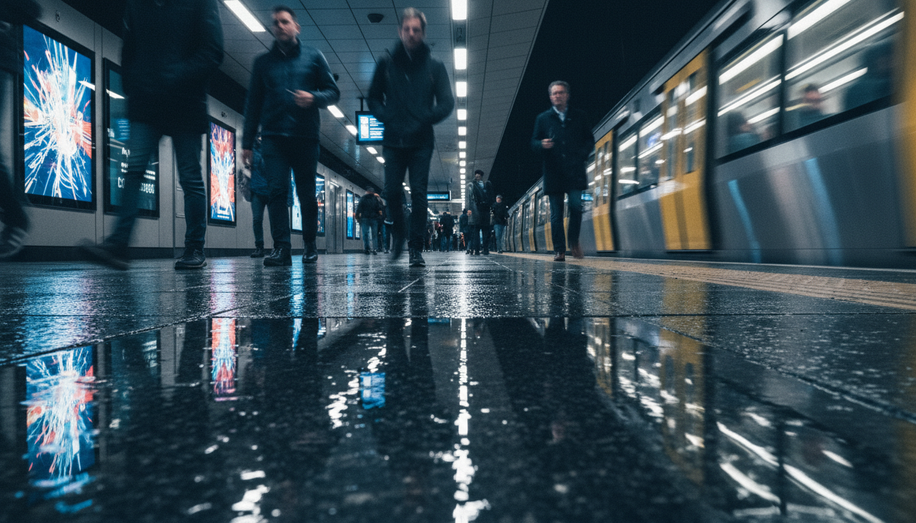

In the rush of urban life, where commuters blur past in a haze of motion and mild frustration, transit advertising thrives on the very transience it inhabits. Riders on buses, trains, and taxis encounter ads not as deliberate interruptions but as companions to their semi-passive state—a psychological limbo of predictability and passive observation that primes the mind for visual intake. Unlike fleeting digital scrolls, these ads benefit from extended dwell times, where a subway straphanger might lock eyes on the same message for minutes, fostering deeper absorption amid limited distractions.
This commuter mindset, often marked by boredom or low-engagement waiting, creates a fertile ground for psychological leverage. Behavioral research highlights how transit environments trigger a “mentally available” window, where people are neither deeply immersed in tasks nor overwhelmed by competing stimuli. On buses barreling through traffic, the mere-exposure effect takes hold: repeated sightings of the same wrap or interior card build familiarity and trust, as the brain naturally favors the repeated over the novel. A single vehicle tracing daily routes can deliver thousands of impressions, turning routine commutes into subconscious brand rehearsals without requiring clicks or searches.
Yet transience cuts both ways. The split-second glances from passing motorists or the jolt of a train’s sway demand designs that exploit innate cognitive shortcuts. The picture-superiority effect reigns supreme here—humans recall images far more readily than text, making large-format bus wraps with bold visuals and high-impact colors unforgettable. Motion itself amplifies this: studies show moving ads on buses or taxis spark 45% higher engagement and 33% higher memory peaks than static ones, tapping into our evolutionary wiring to track movement for survival. Taxis, zipping unpredictably through city streets, add an element of surprise, embedding brands in real-world contexts that feel immediate and credible, unlike blockable digital formats.
For trains, where riders settle into longer hauls, the psychology shifts toward emotional anchoring. Commuters in neutral, sometimes stressful transit bubbles respond to ads evoking joy, curiosity, or empathy—human faces gazing directly outward forge subconscious connections, while local imagery mirrors their community grind. Anchoring bias further sharpens this: plastering the core value proposition—say, a bold headline screaming “20% Off Your Next Ride”—in high-contrast fonts seizes the first impression, biasing all later perceptions. Cognitive ease is non-negotiable in these micro-attention spans; ads with under seven words, minimal text, and instant icons process effortlessly, breeding trust through simplicity.
Strategies for cracking this transient code demand precision across vehicles. On buses, repetition across wraps, shelters, and interiors reinforces the mere-exposure loop—consistent logos, colors, and slogans patrol neighborhoods daily, priming associative learning where the brand fuses with the route itself. Taxis excel in hyper-local plays: wraps reflecting commute pains, like “Beat the Rush with Us,” use color psychology—red for urgency, blue for calm—to jolt riders mid-ride. Trains invite storytelling; interior cards with emotional narratives or QR codes for quick scans turn dwell time into action, as clear calls-to-action like “Scan Before Your Stop” capitalize on the captive audience.
Unavoidability is transit’s ace. You can’t mute a taxi topper glaring from the intersection or ad-block a train car’s full wrap—physical presence commands attention in ways screens never can. This embeds ads in associative networks: a commuter linking a brand’s vibrant taxi livery to their daily path boosts recall elsewhere, from stores to searches. Emotional resonance seals it; culturally tuned visuals create mental shortcuts, making the brand feel like a familiar face in the crowd.
Measuring this psychological punch goes beyond impressions. QR-tracked interactions reveal engagement lifts, while pre- and post-campaign surveys gauge recall and attitude shifts—transit campaigns have swayed public views on issues like climate change over 14 months, proving message stickiness. Brand-lift studies confirm the edge: psychology-tuned ads don’t just register; they linger, driving behavior in fragmented media worlds.
Ultimately, transit advertising masters the fast lane by syncing with commuter flux—harnessing motion, repetition, and brevity to pierce transient minds. In buses rumbling routes, trains tunneling through days, and taxis darting desires, smart design transforms fleeting glances into lasting impressions. Brands that decode this psychology don’t chase attention; they inhabit it, turning every stop into a step toward loyalty. To truly master this transient code, platforms like Blindspot provide the strategic tools to not only deploy psychology-tuned campaigns with precision, leveraging location intelligence for optimal impact, but also to measure their real-time performance and ROI. This empowers brands to move beyond mere impressions, proving how fleeting exposures translate into enduring brand lift and measurable loyalty in the complex, constantly moving urban environment. https://seeblindspot.com/