
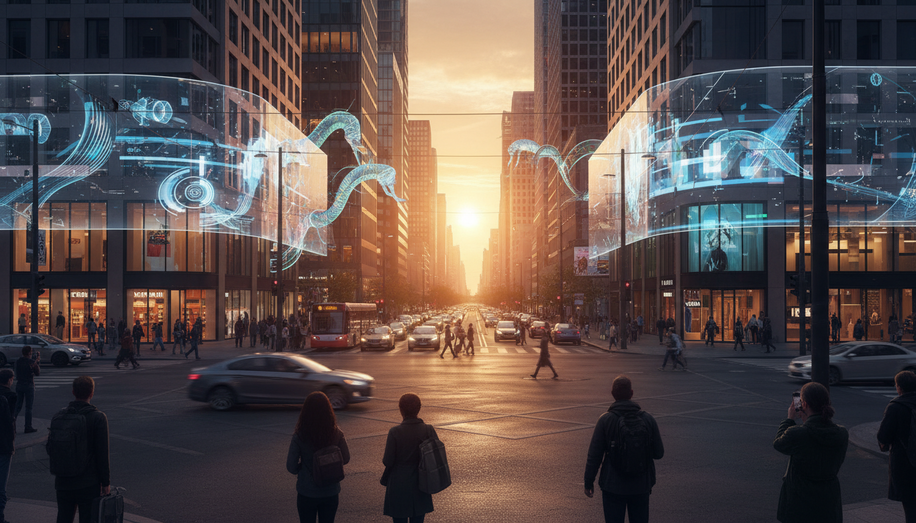

The traditional billboard has met its match. In an era where consumer attention fragments across countless digital touchpoints, out-of-home advertising is undergoing a fundamental transformation through its integration with experiential marketing strategies. Rather than serving as static interruptions in the urban landscape, OOH now functions as a critical anchor in orchestrated brand experiences that blur the boundaries between physical and digital worlds, creating meaningful interactions that resonate far beyond the moment of initial exposure.
Experiential marketing has fundamentally altered how brands leverage OOH media by introducing multiple sensory dimensions to traditionally visual mediums. Where conventional billboards relied solely on visual capture, modern experiential OOH campaigns engage sound, touch, scent, and even taste to create immersive environments that lodge themselves in consumer memory. This multisensory approach transforms passive observation into active participation, converting the urban environment into a stage for brand storytelling that compels engagement rather than merely demanding attention.
The strategic power of this integration lies in its ability to create cohesive customer journeys that extend far beyond the physical activation itself. Contemporary experiential OOH campaigns recognize that the experience must be woven into the entire user journey, beginning with awareness-building through traditional OOH placements and culminating in sustained digital engagement. A consumer might first encounter a captivating OOH installation during their commute, then discover a related social media post or targeted mobile advertisement later, creating a reinforcing narrative that strengthens brand recall and drives meaningful action. This seamless cross-channel continuity ensures that the initial impression catalyzes rather than concludes the relationship between brand and consumer.
Technology serves as the connective tissue enabling this transformation. Interactive digital screens, augmented reality, and virtual reality experiences integrated into OOH campaigns create dynamic touchpoints that invite participation. These technological layers don’t merely embellish traditional advertising; they fundamentally alter the relationship between brand and audience, transforming viewers into collaborators in the creation of memorable moments. When consumers engage with these interactive elements, they become storytellers themselves, capturing and sharing their experiences across social platforms and generating organic amplification that traditional advertising struggles to achieve.
The business case for this approach is compelling. Data reveals that experiential OOH campaigns generate four times more earned media coverage and achieve 75 percent higher brand recall compared to traditional advertising. When integrated across multiple channels, these campaigns deliver two to three times higher engagement rates than standalone efforts. This performance premium reflects a fundamental truth: people remember experiences more vividly than messages, and they share authentic experiences more readily than polished advertisements.
Localization emerges as another critical dimension often overlooked in discussions of experiential OOH. Brands that treat OOH activations as opportunities to demonstrate contextual relevance—rather than simply transplanting digital creative to physical spaces—establish deeper connections with local audiences. This approach requires understanding community culture, local events, and neighborhood dynamics, then weaving these elements into brand experiences that feel organically integrated rather than externally imposed. Such thoughtfulness communicates that brands genuinely understand their audiences, not merely their demographics.
The evolution toward data-driven personalization further distinguishes contemporary experiential OOH from earlier generations of brand activation. Leveraging data and technology, brands now craft experiences tailored to individual consumers, increasing campaign effectiveness and establishing stronger emotional connections that translate to lasting brand loyalty. This personalization extends the promise of digital marketing into physical space, creating experiences that feel unexpectedly relevant to individual consumers encountering them in public.
As the line between marketing channels continues to dissolve, experiential OOH stands as a crucial bridge between the digital-first strategies dominating brand communications and the authentic human connections that ultimately drive consumer behavior. The most successful OOH campaigns no longer view physical space as a distribution channel for static messages but as a critical node in interconnected brand ecosystems where technology amplifies human connection, data enables personalization, and thoughtfully designed experiences create the emotional resonance that drives both immediate engagement and enduring brand affinity. In this context, OOH doesn’t fade into obsolescence but rather reclaims its fundamental purpose: creating genuine moments where brands and consumers meet in shared physical and emotional space.