
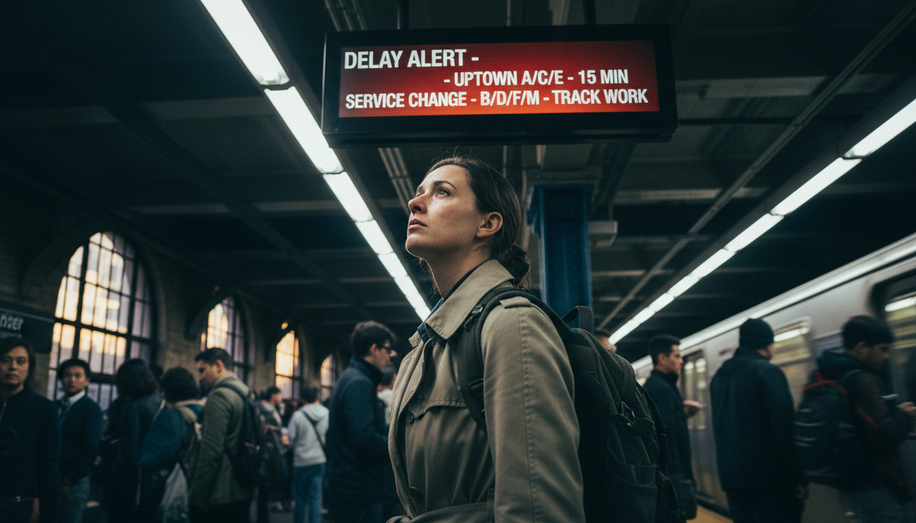

In the dim hum of subway platforms, where commuters huddle against the chill of underground air and the press of bodies, out-of-home (OOH) advertising finds its most potent canvas. Here, minds adrift in the limbo of dwell time—those precious minutes waiting for the next train—become unusually receptive to messages that mirror their immediate reality. Far from generic billboards, hyper-contextual OOH campaigns in public transport environments exploit this mindset, transforming fleeting glances into lasting impressions by syncing visuals, copy, and timing with the commuter’s exact spatial and emotional state.
Consider the subway platform, a microcosm of controlled chaos. Passengers, phones in hand, often enter a state of “mobile immersion” amid crowding, tuning out the physical squeeze by retreating into digital worlds. Research from a major telecom provider’s field experiment reveals a counterintuitive truth: commuters in packed trains—measuring up to five people per square meter—are twice as likely to respond to mobile offers, with purchase rates jumping from 2.1% in sparse cars to 4.3% in jammed ones, even after accounting for peak hours and random ad delivery. This vulnerability stems from crowding’s inward pull, fostering anxiety that ads can relieve like a welcome distraction. OOH advertisers can mirror this by placing digital screens at eye level on platforms, deploying messages that acknowledge the crush: “Stuck in the squeeze? Grab a coffee to go” during rush hour, dynamically triggered by real-time crowd sensors or train delays.
Bus shelters offer a different rhythm, where rain-slicked glass and bench-bound waits create intimate dwell times of 2-5 minutes. Here, relevance hinges on hyperlocal cues—the neighborhood’s vibe, the time of day, or even weather. Digital out-of-home (DOOH) panels excel, swapping creatives automatically: morning ads for coffee runs in residential zones, evening promotions for nearby dinners as shoppers head home. One agency notes that campaigns tailored to specific routes or cultural contexts drive pronounced lifts in platform activity, with hyperlocal resonance converting awareness to action more effectively than broad blasts. Sequencing messages across a shelter’s screens builds narrative—first teasing a problem like “Rainy commute blues?” then solving it with a branded umbrella offer—capitalizing on the captive audience’s limited distractions.
Inside vehicles, the stakes rise with extended exposure. Bus and train interiors deliver 15-45 minutes of uninterrupted views, ideal for layered storytelling on in-car screens. Dynamic placements shine: content shifts by route direction, neighborhood, or disruptions like traffic jams, yielding 2-4 times higher engagement than static ads. Retailers report 5-15% upticks in store visits when messaging activates near target locations, privacy-safely inferred from transit paths rather than personal data. For instance, a quick-service restaurant chain might push lunch deals to eastbound buses passing its outlets at noon, or weather-tied promos during storms—”Warm up inside, 20% off”—ensuring the ad feels prescient, not intrusive.
Placement precision amplifies these tactics. Platforms and shelters demand bold visuals with scannable copy, leveraging high dwell time for longer text that static media can’t match. Target demographics by station: upscale ads in business districts, family-oriented ones near schools. Vehicles suit immersive formats, like looping videos that evolve with the journey. JCDecaux highlights DOOH’s “targeted broadcast,” adjusting copy in real-time for groups based on location, blending OOH’s mass reach with digital agility. Google’s foray into dynamic OOH underscores this evolution, delivering location-based content that feels bespoke without cookies.
Yet success demands more than tech. Creatives must empathize with the commuter’s psyche—fatigued, anticipatory, inwardly focused. Tie into the “travel experience”: route-specific humor for familiar lines, relief from monotony in endless tunnels. Measure impact via footfall trackers, website spikes post-exposure, or brand lift studies, proving ROI in an integrated mix. Cost-effectiveness seals the deal; OOH complements digital cheaply while enhancing public spaces.
Challenges persist—crowding can backfire if ads invade rather than soothe, and off-peak irrelevance wastes impressions. Still, as urban transit swells, hyper-contextual OOH bridges the gap between environment and intent. In these zones of transition, where minds gap between departure and arrival, savvy campaigns don’t just advertise—they inhabit the moment, turning waits into windfalls.