
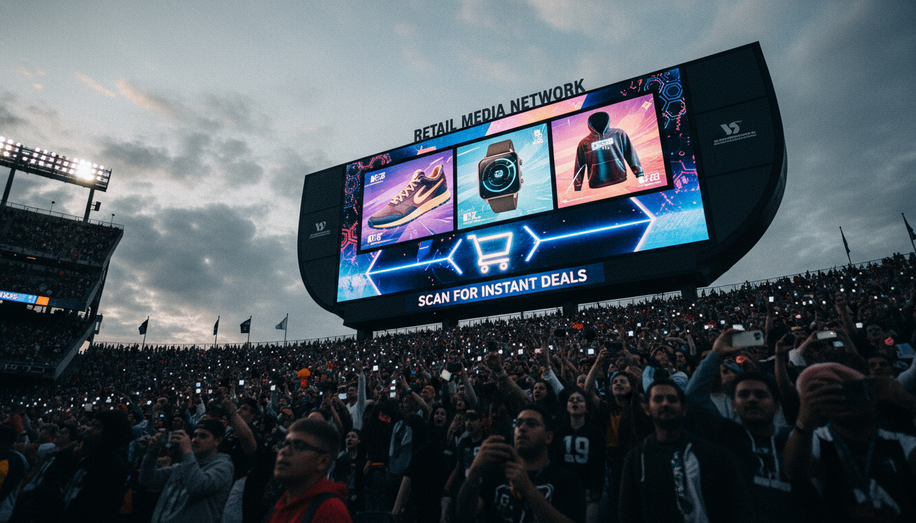

Retailers have spent the last few years building powerful retail media networks, turning their websites, apps and in‑store screens into highly targeted advertising platforms. Yet as sophisticated as these ecosystems have become, they still face a fundamental challenge: connecting digital discovery to real‑world behaviour at scale. This is where out‑of‑home (OOH) advertising is emerging as a strategic force, not just as an awareness driver, but as a performance engine that can push shoppers from online browsing to offline buying.
Retail media networks (RMNs) are, at their core, monetisation engines for a retailer’s owned media. They weave together onsite inventory like sponsored product listings and display ads, offsite programmatic placements, and in‑store digital signage, all powered by rich first‑party data. They excel at reaching shoppers with high intent, especially close to the point of purchase. But their greatest strength—precision—can also be a limitation: most of the engagement happens within a retailer’s own walls or digital properties. OOH extends that reach into the wider world, activating the customer journey long before a shopper hits the digital shelf or the physical aisle.
The most compelling opportunity sits at the intersection of OOH, mobile, and retail data. When retailers combine their first‑party purchase and loyalty data with OOH audience intelligence, they can build geo‑based, time‑based and behavioural strategies that directly fuel store visits. A commuter who repeatedly browses a grocer’s app is served a dynamic OOH message near their typical route home, featuring a personalised promotion available in the nearest store. A pharmacy chain uses RMN segments—such as lapsed beauty buyers or parents with young children—to inform where and when to run digital street furniture and mall screens, then measures the uplift in in‑store transactions against a matched control group. These are no longer speculative brand plays; they are accountable, data‑driven campaigns that plug into the same attribution frameworks retailers already use for their digital networks.
Digital OOH is accelerating this convergence. Programmatic pipes now allow RMNs to treat OOH screens as just another addressable channel in their ecosystem. Retailers, or their media partners, can trigger OOH campaigns based on real‑time signals: weather, stock availability, time of day, or even local search activity. When a home improvement retailer sees a spike in online searches for garden products in a particular area, it can automatically push creative to roadside screens directing shoppers to the nearest store with an in‑stock promise. The RMN provides the intelligence; OOH provides the scale and immediacy in the physical world.
Crucially, OOH also strengthens a retailer’s omnichannel story inside the store. Many retailers already consider in‑store digital screens part of their retail media inventory. But when those screens are connected to broader OOH campaigns outside the store, the result is a cohesive experience that guides the shopper from street to shelf. A shopper might see a campaign for a new snack brand on a digital billboard during their commute, then encounter complementary messaging on entrance screens, digital aisle fins, and point‑of‑sale displays within the same retailer. The repeated, consistent exposure across OOH and in‑store media helps drive both discovery and conversion, with the RMN reporting on the impact across channels.
Measurement is the linchpin that elevates OOH from a “nice‑to‑have” brand amplifier to a core component of RMN strategy. Location data, when used responsibly and in line with privacy regulations, enables visit‑based attribution, tying OOH exposure to store footfall. Retailers can go further by linking that footfall to loyalty and transaction data, proving not only that OOH drove visits, but that those visits translated into incremental sales among specific audience cohorts. For endemic brands—those that already sell through the retailer—this creates a powerful story on share shift and category growth. For non‑endemic brands, it offers a way to tap into the retailer’s audience at scale, using OOH as a bridge from broad awareness to retail‑anchored outcomes.
OOH’s role in the RMN ecosystem is also strategic from a revenue perspective. As retail media grows, retailers face pressure to keep delivering incremental value to brand partners. Onsite and in‑app inventory is finite; retailers cannot endlessly cram more ads into a shopping experience without compromising usability. OOH provides a release valve, expanding the available canvas without overcrowding the digital shelf. It enables retailers to sell “omnichannel packages” that bundle sponsored search, display, in‑store screens, and targeted OOH, priced and optimised against specific objectives such as store traffic, basket size or new product trial.
For OOH media owners, aligning with retail media networks opens the door to deeper integration into performance‑driven budgets. Success will depend on speaking the language of RMNs: audiences, incrementality, closed‑loop measurement, and flexible, API‑driven buying. It also means collaborating closely with retailers and their technology partners to standardise taxonomy and reporting, so that OOH performance can sit alongside onsite and offsite metrics in a single view.
The future of retail media will not be confined to screens a shopper actively taps or scrolls. It will play out in a continuum of touchpoints that begin on a phone, pass through a billboard or transit screen, and culminate in a store visit and a scanned receipt. Out‑of‑home is uniquely positioned to orchestrate that online‑to‑offline journey: highly visible, increasingly addressable, and now measurable against the same business outcomes that drive RMN investment. As retailers race to build the next generation of their media networks, those that fully integrate OOH into their strategy will be better equipped to capture attention in the wild and convert it at the shelf.