
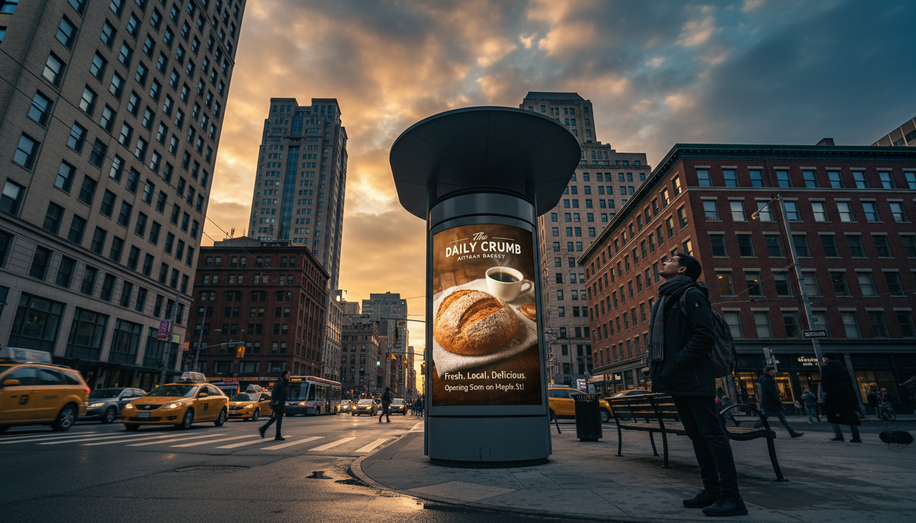

For years, bus shelters have been the workhorse of street-level out-of-home, reliably delivering impressions from commuters at eye level. But as brands demand sharper targeting and measurable impact from their OOH budgets, the focus is shifting to a broader, more nuanced canvas: the full spectrum of street furniture. Benches, kiosks, bike-share docks, pedestrian panels, mall ad units, and public information displays are emerging as precision tools for micro-targeted, context-aware campaigns that feel less like broadcast and more like a well-timed nudge.
What makes street furniture uniquely powerful is its ability to plug directly into the rhythms of local life. These assets sit where people sit, wait, walk, check their phones, and look for directions. They serve as public amenities first—places to rest, navigate, or access services—and advertising vehicles second. That dual role creates an unusually receptive environment. A commuter scanning a digital kiosk for transit updates or a visitor checking a wayfinding panel is already in “information mode,” primed to notice a message that’s relevant to their immediate context.
Micro-targeting in this setting isn’t just about geographic precision, though that’s the starting point. Street furniture can be deployed at the level of a single intersection, a specific retail corridor, or the streets surrounding a campus or stadium. Bench ads outside a medical clinic can support healthcare campaigns; bike-share docks surrounding a university can feature fintech or food delivery brands speaking directly to students; pedestrian panels near a fitness trail can promote athleisure or hydration products. Each location has a behavioral profile that can be matched with a message designed for that micro-audience.
The rise of digital street furniture and programmatic DOOH is accelerating this shift. Static posters on benches and shelters still have enormous value, especially for sustained brand-building in a neighborhood. But digital units—Link-style kiosks, interactive wayfinding screens, digital transit shelters, and mall panels—introduce a layer of dynamism that makes hyper-local and hyper-timely messaging possible. Creative can change by time of day, day of week, or even in real time based on triggers like weather, local events, or transit conditions.
A coffee brand, for example, can dominate kiosks and bus shelters around business districts during the morning rush, then cede the same screens to a rideshare or food delivery app in the late evening. A sporting goods retailer can light up panels near a stadium with pre-game hype, then pivot post-game to promote discounts if the home team wins. When inventory is bought programmatically, these campaigns can be flighted and optimized with the same agility digital marketers expect from online media, but grounded in the high-impact physicality of street-level displays.
Context-aware creative is where micro-targeting moves from media planning theory to tangible effectiveness. It’s not enough to place a generic brand message on a bench and call it localized. The strongest campaigns use the specifics of place and moment. A bench ad at a bus stop near a grocery store might speak to “one last stop before dinner,” while the same brand, on a kiosk in a nightlife district, leans into late-night snacking. Digital panels along a tourist-heavy promenade can welcome visitors in multiple languages and highlight proximity-based offers—“Two blocks away: free tasting until 4 p.m.”—using QR codes to close the loop between exposure and action.
Mobile integration is now table stakes for street furniture, particularly for younger, constantly connected audiences. Eye-level formats invite quick scans and taps: QR codes leading to mobile landing pages, app download pages, or time-sensitive vouchers; short URLs and NFC tags that reward interaction; social handles and hashtags that encourage sharing. Research consistently shows that OOH can be a powerful driver of mobile search and social engagement; street furniture, with its dwell times and intimate viewing distance, is often the OOH format best positioned to trigger that behavior.
Measurement, once the Achilles’ heel of OOH, is also advancing in step with these micro-targeted deployments. Planners are layering anonymized mobile location data over street furniture networks to estimate audience profiles, frequency, and movement patterns before buying. Post-campaign, the same data can help attribute store visits, app opens, or web traffic lifts to exposure around specific units or clusters. In dense urban environments, this turns what used to be “nice to have” neighborhood coverage into a testable, optimizable media channel.
For municipalities and property owners, the micro-targeted use of street furniture is also rewriting the value equation. Traditionally, these amenities were justified by the public service they provided, with advertising revenue as a supporting argument. Now, cities are partnering with media owners to create smarter, more connected networks of street furniture: digital kiosks providing transit data, public Wi-Fi, and emergency alerts alongside rotating ad inventory; bike-share systems with branded docks and contextual creative encouraging sustainable travel; mall and transit hubs with cohesive, advertiser-supported wayfinding ecosystems. The better these networks serve the public, the more engaging and credible the advertising that appears on them.
To unlock the full potential of micro-targeted street furniture, brands and agencies need to rethink their creative and planning processes. Street furniture campaigns work best when they’re designed from the ground up for locality: dozens of variants tailored to different neighborhoods, dayparts, or audience segments rather than a single master visual pushed everywhere. That requires closer collaboration between media, creative, and data teams, as well as a willingness to embrace modular design: consistent brand elements, but flexible messaging that can snap into place depending on context.
The payoff is a form of OOH that feels less like wallpaper and more like a service—ads that acknowledge where you are, what you’re doing, and what you might need next. Beyond bus shelters, the street itself is becoming a finely gridded canvas. Benches, kiosks, public information panels, and other street furniture assets are no longer just background fixtures; they are precision instruments for brands to speak directly, and meaningfully, to the micro-communities that move past them every day.
For brands and agencies looking to master this new finely gridded canvas, solutions are emerging to bridge the gap between ambition and execution. Platforms like Blindspot empower advertisers with programmatic DOOH campaign management, enabling the hyper-local and hyper-timely messaging discussed, while providing robust location intelligence and audience measurement to ensure campaigns are precisely targeted and optimized for true impact. By offering real-time performance tracking and clear ROI measurement, Blindspot helps transform street furniture into a truly testable, attributable, and agile media channel, delivering messages that resonate directly with micro-communities at the right place and moment. Learn more at https://seeblindspot.com/