
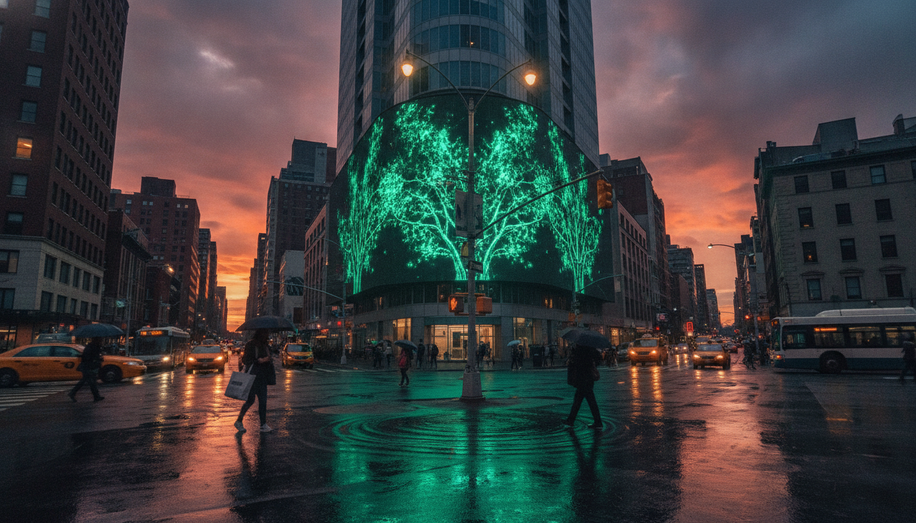

In an era where digital noise is inescapable and consumers have developed a collective, subconscious filter for standard advertisements, the physical world offers a different kind of canvas. Out-of-home (OOH) advertising has long relied on scale and high-traffic visibility to make an impact, but the medium’s true superpower lies in its physical geography. When a billboard stops merely occupying space and begins actively conversing with it, the ad transcends commercial messaging and becomes an experience. This is the art of context—a creative strategy where the immediate environment is not just a backdrop, but the very catalyst for the campaign’s narrative.
To master this approach, agencies are moving away from the \”one-size-fits-all\” creative asset and embracing hyper-local spatial design. When a campaign physically interacts with its surroundings, it demands attention through clever illusion and integration. Consider the iconic campaigns that turn a nearby tree into a model’s hair, utilize the shadow cast by a lamppost to reveal a hidden message at sunset, or frame a billboard to make it look as though a product is bursting through the concrete of an adjacent building. By treating structural anomalies, architectural lines, and even the natural elements of a streetscape as design partners, creative directors can craft visuals that feel native to their location. This integration rewards the viewer for looking closely, shifting the consumer’s role from passive observer to active participant in a visual puzzle.
The evolution of Digital Out-of-Home (DOOH) has added a fluid, real-time dimension to this contextual dance. Programmatic technology now allows ads to react dynamically to shifting environmental cues such as local weather patterns, traffic density, or UV indexes. A cosmetic brand might display heavy-duty sunscreen ads only when the UV index spikes, or a hot beverage brand might serve a steaming mug visual the exact moment the local temperature drops below freezing. Because these ads reflect the viewer’s immediate physical reality—the chill they feel, the rain they are actively dodging, or the traffic they are sitting in—the messaging carries an unparalleled level of relevance. It bypasses the brain’s filtering mechanisms because it addresses a present, tangible truth.
Beyond the physical and the digital, there is a deep psychological context tied to specific locations. A person standing on a crowded subway platform on a rainy Monday morning possesses an entirely different headspace than that same person walking through a sunny municipal park on a Saturday afternoon. Designing for context means matching the creative tone to the emotional register of the space. Ads placed in transit hubs do well to acknowledge the frantic energy of the commute with concise, witty, or calming copy. Conversely, airport terminals, where dwell times are notoriously high, offer an opportunity for deeper storytelling, interactive QR codes, or experiential installations. Understanding the cognitive load of a passerby at any given coordinate ensures that the creative speaks to the consumer, rather than just shouting at them.
The friction in executing highly contextual OOH lies in scalability. Customizing creative to fit the distinct architecture of twenty different street corners or programming dozens of dynamic DOOH triggers requires greater investment in pre-production, site inspection, and creative strategy. However, the return on this effort is often reflected in unmatched brand recall and viral social media amplification. A brilliant contextual ad is rarely just seen by those who walk past it; it is photographed, shared, and discussed globally, extending its reach far beyond its physical footprint. In a landscape where attention is the ultimate currency, the brands that learn to play with their surroundings are the ones that will truly stand out.