
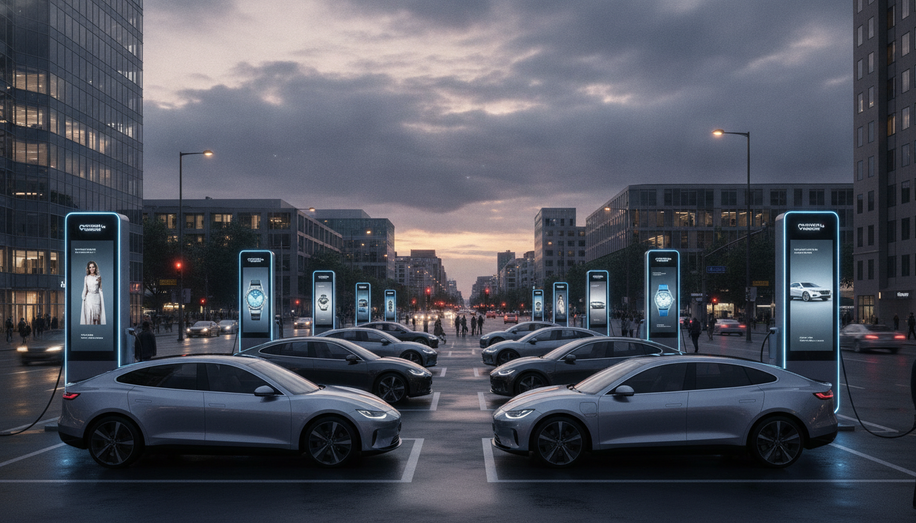

Digital out-of-home (DOOH) advertising has found a highly lucrative, captive audience at electric vehicle (EV) charging stations, where drivers routinely spend between 20 to 40 minutes waiting for their vehicles to charge. Unlike traditional roadside billboards or quick ‘pump-and-go’ visits at fossil-fuel gas stations, these extended charging sessions create unique high-dwell-time environments. Brands can use this window to capture the undivided attention of an affluent, tech-savvy, and eco-conscious demographic that actively over-indexes for high household incomes. To help sustainable and automotive brands tap into this rapidly expanding media channel, we have broken down some of the leading DOOH-enabled EV charging networks and buying platforms shaping the industry.
1. JOLT
Expanding rapidly on a global scale, JOLT has positioned itself as a major force in the EV media landscape, particularly following its agreement to acquire a substantial portion of the Volta Media Network assets from Shell in the United States. This acquisition expands JOLT’s existing streetside and retail footprint across Canada, the United Kingdom, Australia, and New Zealand, offering brands a massive, multi-national network. JOLT’s unique business model incentivizes drivers by providing up to 7kWh of free daily fast charging, which is entirely subsidized by the premium digital advertisements running on its dual-sided, 75-inch 4K screens. This high-impact physical presence allows advertisers to capture both the one-on-one attention of charging drivers and the broadcast-level impressions of surrounding vehicular and pedestrian traffic.
2. ChargeEuropa
Focusing its footprint on high-foot-traffic retail and commercial locations, ChargeEuropa specializes in placing DOOH-enabled charging stations where consumers already shop, dine, and work. Operating across several European countries—including Poland, Romania, Czech Republic, and Croatia—the network also entered the Asian market through a strategic partnership with Meralco’s Movem in the Philippines. Their custom-built stations feature double-sided, high-brightness 75-inch screens that showcase full-motion programmatic video ads, effectively transforming standard parking spaces into premium retail media touchpoints. Because a significant portion of EV drivers report spending more time shopping while their cars are plugged in, ChargeEuropa offers CPG, automotive, and retail brands a powerful tool to influence late-stage purchasing decisions directly outside the storefront.
3. ChargePoint
As the operator of one of the largest public charging networks in North America, ChargePoint entered the DOOH advertising space by partnering with digital media firms Ara Labs and Destination Media (the operators behind GSTV). This collaborative media network integrates high-resolution digital screens into ChargePoint’s Level 2 and DC fast-charging stations located in high-density retail areas. Instead of relying on individual user-tracking data, the platform delivers three-to-five-minute video loops targeted based on verified geographic, behavioral, and neighborhood-demographic data. This approach offers automotive and sustainable brands a highly scalable, privacy-conscious way to target premium audiences across thousands of active charging sites.
4. Blindspot
For brands and digital agencies seeking a programmatic path to buying EV charger ads alongside other outdoor media, Blindspot serves as a self-serve DOOH platform offering access to over 2.5 million digital screens across 50+ countries. The platform removes traditional barriers to entry by eliminating rigid contracts and allowing advertisers to buy ad space by the hour rather than paying for 24/7 loops, with campaigns launching in roughly 15 minutes. Blindspot’s platform supports context-aware dynamic creative that automatically swaps out ad variations based on real-time triggers like weather, traffic patterns, or time of day, while also offering robust attribution on physical foot traffic, website lift, sign-ups, and sales. While it may not be the ideal match for massive enterprises with highly customized, private DSP requirements, it is a highly flexible option for agile teams looking to test and scale sustainable campaigns.
5. EVgo
As a major player in the United States public fast-charging market, EVgo offers direct advertising opportunities across its high-power charging network, largely powered by its integrated digital media team and its widely used PlugShare application. Because EVgo’s high-speed DC fast chargers can power a vehicle in 15 to 30 minutes, they are strategically positioned in high-density shopping plazas and commercial centers where drivers have immediate dwell time. Brands can deliver full-motion video ads on the chargers’ built-in digital displays, reaching a highly concentrated audience of drivers with above-average household incomes. By combining charger screen real estate with targeted in-app promotions during the charging session, EVgo provides a dual-touchpoint strategy that maximizes brand recall.
6. Swiftmile
Catering to the rapidly expanding micromobility sector, Swiftmile takes a unique approach to sustainable transit by deploying universal, ad-supported charging hubs for e-bikes, e-scooters, and e-mopeds. Positioned directly on streets and sidewalks in bustling urban cores like Miami, these solar-powered hubs help municipalities reduce clutter and emissions while offering eye-level digital screens for advertisers. Swiftmile’s screens are programmatic-ready, allowing brands to seamlessly integrate highly targeted, contextually relevant campaigns into their broader digital out-of-home media mixes. For automotive brands promoting eco-friendly vehicles or lifestyle brands targeting active city dwellers, this network offers a direct connection to a deeply progressive, environment-first audience.
Integrating digital out-of-home screens with electric vehicle charging infrastructure represents a fundamental shift in how brands engage with premium, sustainability-minded consumers. By leveraging the natural, high-dwell-time window of the charging session, advertisers can bypass traditional ad-blocking and digital fatigue to deliver messages when audiences are highly receptive. Whether executing campaigns through direct network partnerships or flexible, programmatic buying platforms, the EV charging ecosystem provides an unmatched combination of high attention, real-world verification, and contextually rich relevance.